Route inspiration
Best road trip routes in Europe
Europe is built for road trips: a continent of hairpin mountain passes, cliff-edge coast roads and storybook villages, all close enough together that a fortnight can take in glaciers, beaches and vineyards. These are nine of the best road trip routes in Europe — coastal classics, white-knuckle alpine passes and gentle touring roads — each with its length, the highlights, the best time to go and an honest note on how demanding the driving is. There's a section at the end on the practical side of a European road trip for UK drivers, from which side of the road you'll be on to vignettes and tolls. Pick a route, block out the dates, and start mapping the stops.
Start planning now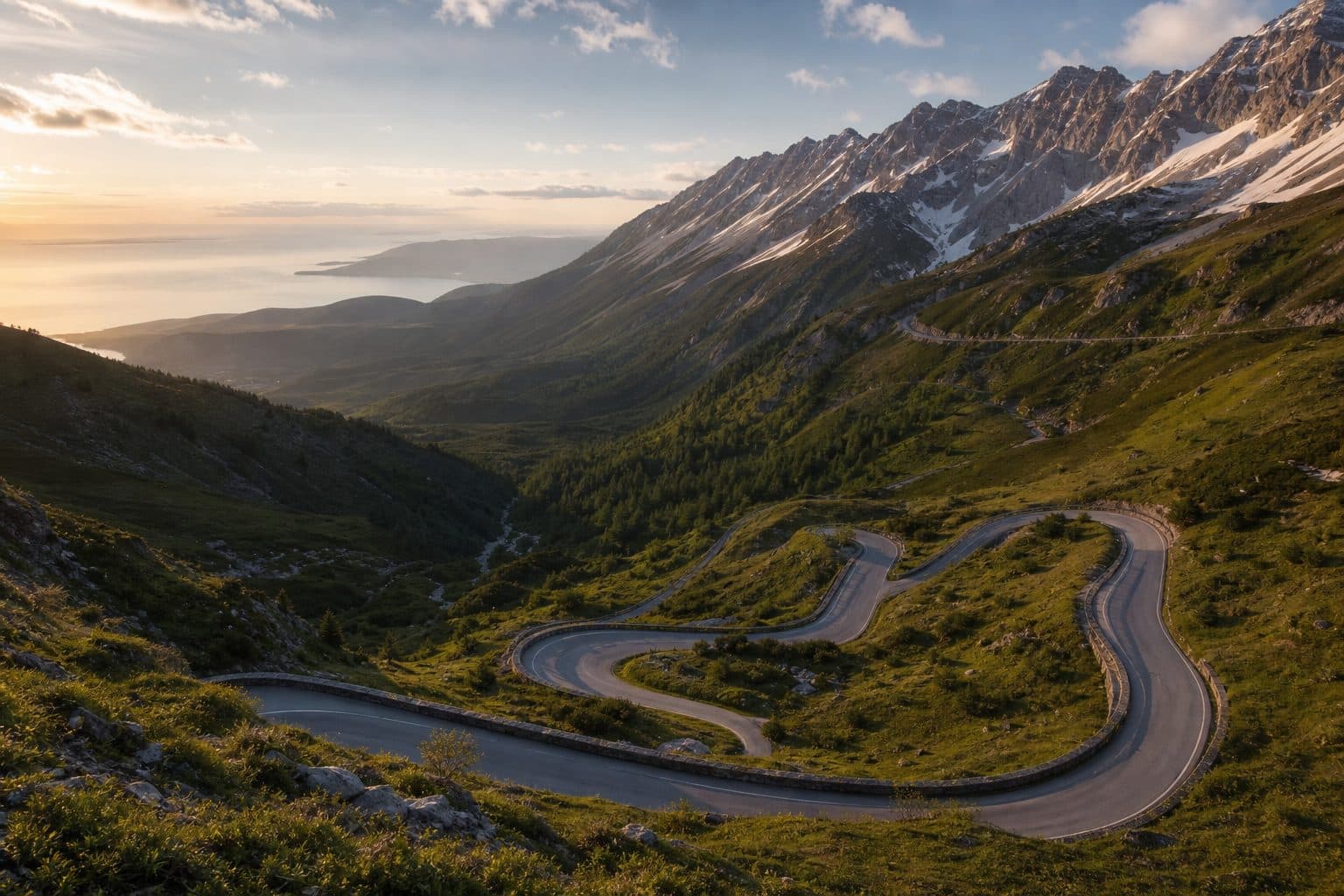
Coastal drives
Sea on one side, mountains on the other, and a viewpoint round every bend. These are the routes people picture when they imagine a European road trip — slow, scenic and best driven with the windows down.
Amalfi Coast Road (SS163), Italy
Approx. 50 km · ChallengingThe SS163 hugs the cliffs from Sorrento to Salerno, threading through Positano, Amalfi and the lemon-terraced hillside town of Ravello. It's narrow, busy and full of blind bends and tour buses, so it rewards a calm driver and an early start. Go in late spring or early autumn to dodge the worst of the summer traffic and heat.
Atlantic Ocean Road (Atlanterhavsveien), Norway
Approx. 8 km · EasyA short but spectacular causeway of bridges that hops between islets on Norway's west coast, the Storseisund Bridge appearing to launch into the sea. It's an easy drive linked into longer fjord touring around Molde and Kristiansund. Summer brings the calmest conditions; an autumn storm makes the waves crash over the road for the drama-seekers.
Ring of Kerry, Ireland
Approx. 180 km · ModerateA loop from Killarney around the Iveragh Peninsula, with mountain passes, sandy bays and the Skellig views out west. A gentle bonus for UK drivers: Ireland drives on the left, so it's the least daunting route on this list. Coaches tend to run anticlockwise, so going clockwise keeps you off their bumper. Best from May to September.
Mountain passes and alpine roads
Switchbacks, summits and air that thins as you climb. These are the bucket-list drives — exhilarating, occasionally nerve-jangling, and only open for part of the year, so check the road is clear of snow before you commit.
Transfăgărășan (DN7C), Romania
Approx. 90 km · ChallengingRomania's most famous road climbs into the Făgăraș Mountains in a frenzy of hairpins to the glacial Bâlea Lake, with a tunnel through to the southern side. The high section is typically only open from around July to October, closing once the snow returns. Drive it midweek and early to have the bends to yourself.
Grossglockner High Alpine Road, Austria
Approx. 48 km · ModerateA toll road of 36 numbered hairpins that crests above 2,500 m, with a spur to the viewing terrace facing the Pasterze Glacier and Austria's highest peak. It usually opens from early May to late October, weather permitting. Set off early for clear views before the afternoon cloud builds over the summits.
Stelvio Pass (SS38), Italy
Approx. 49 km · ChallengingOne of the highest paved passes in the Alps, the Stelvio stacks 48 numbered hairpins up the Eastern Alps near the Swiss border — a wall of switchbacks that's a rite of passage for drivers and cyclists alike. It's typically open from June to October. Be patient with the bikes and motorcyclists, and use low gears on the long descent.
Route des Grandes Alpes, France
Approx. 700 km · ChallengingA grand traverse of the French Alps from Lake Geneva down to the Mediterranean at Menton, stringing together many of the great cols including the Galibier and the Iseran. Several of the highest passes only open in summer, so the classic window is roughly late June to September. Allow several unhurried days rather than trying to rush it.
Scenic touring routes
Lower, gentler and easier on a nervous driver, these are the routes for soaking up villages, castles and valleys rather than conquering summits. Ideal for a first European road trip or a trip with the family in tow.
Romantic Road (Romantische Straße), Germany
Approx. 350 km · EasyA signed touring route through Bavaria from Würzburg to Füssen, linking walled medieval towns like Rothenburg ob der Tauber and finishing near the fairy-tale Neuschwanstein Castle. The driving is relaxed and the distances short, so it suits a leisurely week. Lovely in autumn, and magical in December for the Christmas markets.
Great Dolomites Road, Italy
Approx. 110 km · ModerateFrom Bolzano to Cortina d'Ampezzo through the pale, jagged peaks of the Dolomites, over passes like the Pordoi with some of the most photogenic mountain scenery in Europe. Manageable hairpins and frequent viewpoints make it a more forgiving alpine drive. Best from June to September, when the high passes are reliably open.
Driving in Europe: what UK drivers need to know
A European road trip is mostly common sense, but a few things catch out first-timers from the UK. Sort these before you go and the rest is just enjoying the road. Rules change, so always check the latest government and AA/RAC guidance for each country you'll drive through.
You'll be driving on the right
Except IrelandAlmost all of mainland Europe drives on the right, so a left-hand-drive hire car makes overtaking and tolls far easier than taking your own. If you do take a right-hand-drive car, fit beam deflectors and be extra cautious overtaking. Ireland, like the UK, drives on the left.
UK sticker and documents
Cars with UK plates need a 'UK' sticker (the old 'GB' sticker no longer counts) unless your number plate already shows the UK identifier on its own. Carry your full photocard driving licence, V5C logbook, and proof of insurance.
Insurance and breakdown cover
Tell your insurer you're driving abroad and check you have at least third-party cover for every country on the route; ask whether a green card is needed. European breakdown cover is well worth it for the peace of mind so far from home.
Vignettes and tolls
Many countries — including Austria, Switzerland, Slovenia, the Czech Republic and Hungary — require a vignette (a road-use sticker or digital pass) bought in advance for motorways. Others, like France, Italy and Spain, use pay-as-you-go toll booths. Some alpine roads, such as the Grossglockner, charge a separate toll.
Mandatory kit varies by country
Several countries legally require items such as a warning triangle, hi-vis jackets for everyone in the car, and a first-aid kit; a few ask for spare bulbs or a breathalyser. Pack a kit that covers the strictest country on your route so you're never caught short.
Low-emission zones and city driving
Many European cities now have low-emission or restricted zones that need a windscreen sticker or pre-registration to enter, with fines for getting it wrong. Check each city before you arrive, and where you can, park on the edge and use public transport into the centre.
How to choose the right route for you
The best European road trip is the one that matches your driver, your dates and your nerve. If it's your first time on the right, start with a gentle touring route like the Romantic Road or the Ring of Kerry before tackling the big alpine passes. Travelling with children or a hesitant driver? Favour the coastal and scenic routes over the white-knuckle hairpins. Chasing the high passes like the Transfăgărășan, Stelvio or Grossglockner? You're tied to summer and early autumn, when they're clear of snow — build in slack for weather, and never assume a high road is open without checking. Map your stops day by day, keep daily distances realistic on twisting roads, and leave room to pull over for the views — they're the whole point.
Best road trip routes in Europe FAQ
What is the best road trip route in Europe?
There's no single best route — it depends on what you're after. For sheer drama, Norway's Atlantic Ocean Road and Romania's Transfăgărășan are hard to beat; for classic coastal scenery, the Amalfi Coast and the Ring of Kerry; for a relaxed first European road trip, Germany's Romantic Road. Match the route to your driver, your dates and how confident you are on mountain roads.
When is the best time for a European road trip?
Late spring (May–June) and early autumn (September) hit the sweet spot of good weather, long days and fewer crowds than peak July and August. High alpine passes such as the Stelvio, Grossglockner and Transfăgărășan are only reliably open from around June or July to October, so if your route includes them, plan for summer and always check the road is clear of snow before you set off.
Do I need a vignette to drive in Europe?
In some countries, yes. Austria, Switzerland, Slovenia, the Czech Republic, Hungary and several others require a vignette — a road-use sticker or digital pass bought in advance — to use their motorways. Others, including France, Italy and Spain, charge pay-as-you-go tolls at booths instead. Check each country on your route before you travel and buy any vignettes ahead of crossing the border.
Is it better to hire a car or take my own to Europe?
For driving on the right, a left-hand-drive hire car picked up on the continent makes overtaking, tolls and parking far easier and saves the mileage and wear on your own car. Taking your own car works well for shorter trips or where the ferry or tunnel cost outweighs hire, but fit headlamp beam deflectors and take extra care overtaking from the 'wrong' side.
What documents do UK drivers need to drive in Europe?
Carry your full UK photocard driving licence, your V5C logbook, and proof of valid insurance for every country you'll drive in. Your car needs a 'UK' sticker unless the number plate already shows the UK identifier. An International Driving Permit isn't usually required for short trips in EU and EEA countries, but check the rules for each country, as requirements can change.
How long do you need for a European road trip?
It depends on the route. A short coastal drive like the Atlantic Ocean Road or a single alpine pass can be a day's highlight within a longer trip, while touring routes like the Romantic Road suit a relaxed week and a grand traverse like the Route des Grandes Alpes deserves several unhurried days. As a rule, keep daily distances modest on twisting mountain roads and leave plenty of time to stop for the views.